



Instant Asset Write-Off 2026-27: The Complete $20,000 Guide for Small Businesses
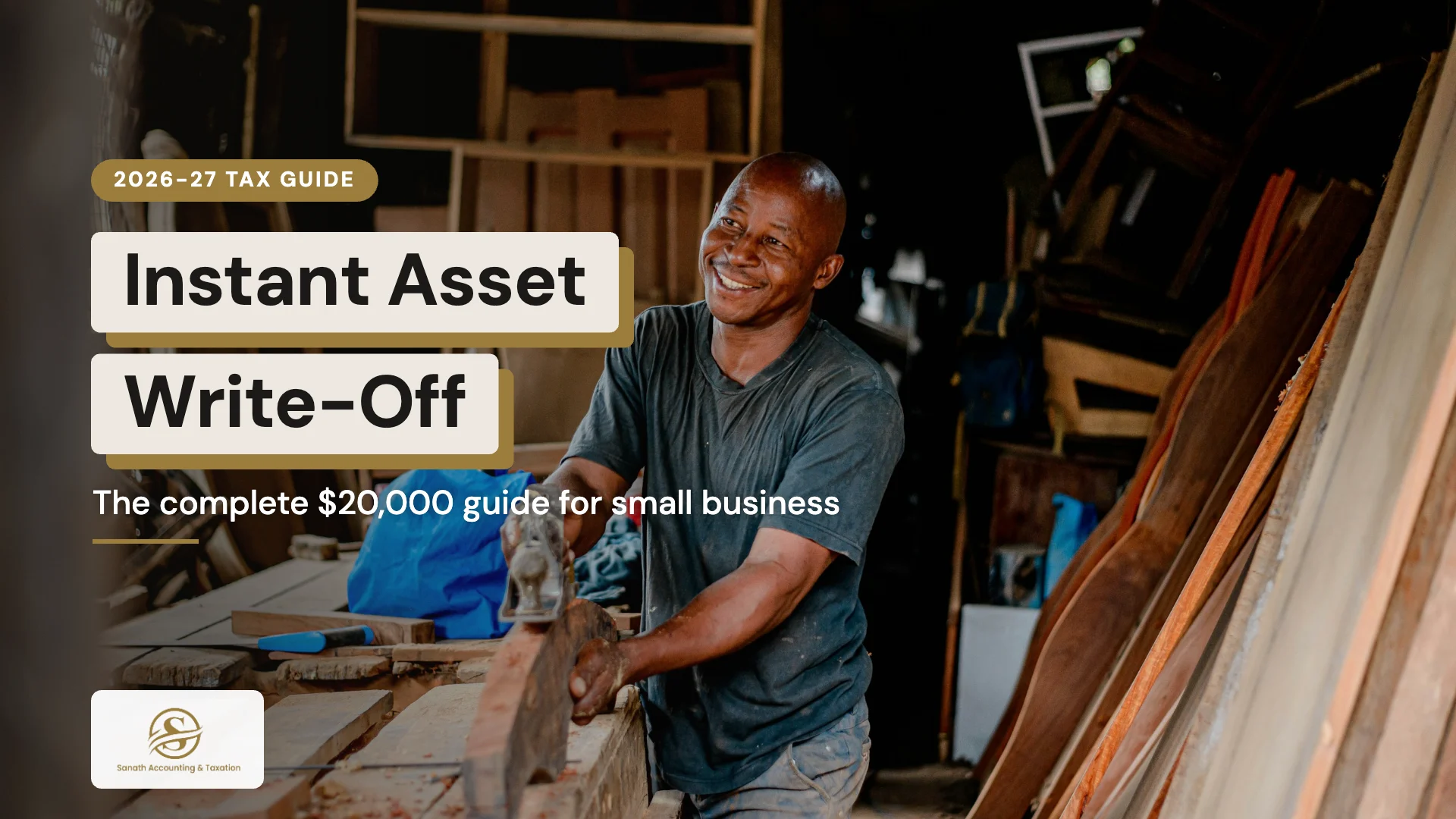
The instant asset write-off is now a permanent part of the Australian tax system, and it could put real cash back into your business this year. From 1 July 2026, eligible small businesses can immediately deduct the business-use portion of any asset that costs less than $20,000.
That means no more waiting for last-minute extensions. It is also one of the most useful small business tax deductions available, because you can plan equipment purchases with confidence.
But the rules still matter. Turnover limits, timing, mixed-use assets and record keeping can all affect your claim. Get one of them wrong and the ATO can reduce your deduction.
This guide explains how the instant asset write-off works in 2026-27, who qualifies and what you can claim. It also covers the mistakes we see most often. It is written for business owners in Parramatta, Norwest, Blacktown and across Western Sydney. If you would rather talk it through, book a free 20-minute call with our team.
Instant Asset Write-Off at a Glance
- The threshold is $20,000 per asset, and it is permanent from 1 July 2026.
- Your business needs aggregated turnover below $10 million.
- The asset must be first used or installed ready for use in the income year.
- You can only claim the business-use portion of the cost.
- Assets costing $20,000 or more go into the small business pool instead.
What Is the Instant Asset Write-Off?
Normally, when you buy business equipment, you claim its cost gradually as depreciation. That can take years. The instant asset write-off lets you skip the wait. You deduct the business-use cost of an eligible asset in full, in the year you start using it.
Bringing that deduction forward lowers your taxable income now. That improves cash flow, which is why the measure is so popular with small businesses.
For years, the threshold changed almost every Budget. The most recent extension covered 1 July 2025 to 30 June 2026. That uncertainty is over. The ATO has confirmed that the $20,000 instant asset write-off is here to stay from 1 July 2026.
How the $20,000 Threshold Works
The $20,000 limit applies to each asset, not to your total spending. You can write off several assets in the same year, as long as each one costs less than $20,000.
- GST-registered businesses: the cost is measured excluding GST.
- Businesses not registered for GST: the cost includes GST.
- Mixed-use assets: only the business-use portion is deductible.
For example, you could buy a $9,000 machine, a $4,500 laptop and a $6,000 trailer in the same year. Each one is below $20,000, so each one can be written off immediately.
Is the Instant Asset Write-Off Really Permanent?
Yes. The Government announced the change in the 12 May 2026 Federal Budget, and it has since passed into law. The ATO now lists the measure as permanent for eligible assets from 1 July 2026. Even so, check the ATO’s instant asset write-off page before any large purchase, in case conditions change.
Who Is Eligible for the Instant Asset Write-Off?
You can use the write-off if you run a small business and meet these conditions:
- Your aggregated turnover is less than $10 million.
- You use the simplified depreciation rules for small business.
- The asset is a depreciating asset, either new or second-hand.
- The asset was first used, or installed ready for use, between 1 July 2026 and 30 June 2027.
What Is Aggregated Turnover?
Aggregated turnover is your business income plus the income of any connected entities and affiliates. If you own more than one business, or run a company and a trust together, you need to add them up. This catches out more owners than you might expect.
Sole Traders, Companies and Trusts
The instant asset write-off is open to sole traders, companies, partnerships and trusts. If you work as a contractor, the same rules apply when you earn through your own business.
The deduction is the same, but the tax you save depends on your structure. A company taxed at the 25% base rate entity rate saves 25 cents for each dollar deducted. A sole trader saves at their personal marginal rate.
What Can You Claim Under the Instant Asset Write-Off?
Most depreciating assets used in your business can qualify. These are assets that lose value as you use them. Common examples include:
- Computers, laptops, phones and tablets
- Point-of-sale systems and card terminals
- Commercial kitchen and café equipment
- Tools, machinery and workshop equipment
- Office furniture and fit-out items that are not part of the building
- Medical, dental and beauty equipment
- Work vehicles, subject to the car limit
Many Western Sydney businesses use the write-off for trade tools, hospitality equipment and technology upgrades.
Assets You Cannot Claim
- Buildings and structural improvements, which have their own capital works deduction
- Trading stock that you buy to resell
- Assets that cost $20,000 or more
- Certain assets you lease out on a long-term basis, and horticultural plants
Cars need extra care. A passenger car is subject to the ATO’s car limit, so the full price of a premium car may not be deductible. A work ute or van may be treated differently, depending on its design and carrying capacity. Check before you buy.
Mixed-Use Assets and the Business-Use Portion
If you use an asset for both business and private purposes, you can only claim the business share. Say you buy a $3,000 laptop and use it 80% of the time for work. Your deduction is $2,400.
Keep a simple diary or logbook to support the percentage. The ATO may ask for proof.
Instant Asset Write-Off Example: How Much Tax Could You Save?
The table below shows how the write-off could work for four Western Sydney businesses. Each example assumes the business is a company taxed at the 25% base rate entity rate.
| Business | Asset purchased | Cost (ex GST) | Business use | Deduction | Tax saved at 25% |
|---|---|---|---|---|---|
| Parramatta café | Commercial coffee machine | $12,500 | 100% | $12,500 | $3,125 |
| Norwest electrician | Test equipment and tools | $9,000 | 100% | $9,000 | $2,250 |
| Blacktown retailer | POS system and scanners | $6,400 | 100% | $6,400 | $1,600 |
| Consultant | Laptop and monitors | $3,200 | 75% | $2,400 | $600 |
Why the Instant Asset Write-Off Is a Timing Benefit, Not Free Money
A deduction reduces your tax. It does not cover the cost of the asset. If you spend $10,000 and save $2,500 in tax, you are still $7,500 out of pocket. Buy what your business genuinely needs, then let the deduction ease the cost.
If your business made a loss, the deduction adds to your tax loss instead of reducing tax straight away. The benefit may come later. A short tax planning conversation before you buy can save you from that surprise.
Instant Asset Write-Off vs the Small Business Depreciation Pool
What if your asset costs $20,000 or more? You cannot use the write-off for that asset. You can usually claim it through the small business simplified depreciation pool instead.
| Asset cost | How you claim | First-year deduction |
|---|---|---|
| Less than $20,000 | Instant asset write-off | 100% of the business-use cost |
| $20,000 or more | Small business pool | 15% of the cost |
After the first year, the pool is deducted at 30% of the balance. A $30,000 machine would give a first-year deduction of $4,500 through the pool. The same business could deduct the full cost of a $19,900 machine at once.
9 Proven Tips to Maximise Your Instant Asset Write-Off
Here is how we help clients get the most from this deduction without creating problems later.
1. Confirm Your Turnover First
Work out your aggregated turnover before you buy. If you are close to $10 million, include connected entities in the calculation.
2. Watch the First-Use Date
The asset must be first used, or installed ready for use, by 30 June 2027 to count in 2026-27. Buying it in June is not enough if it is still sitting in a box.
3. Keep Every Tax Invoice
Store invoices, proof of payment and delivery or installation dates. The ATO generally expects you to keep business records for five years.
4. Separate Business and Private Use
Set a clear business-use percentage and keep evidence. Use a logbook for vehicles. Consider keeping a dedicated business device.
5. Be Careful When Splitting Purchases
The limit is per asset, but items that work together may be treated as one asset. Do not split a purchase just to stay under $20,000 without advice.
6. Claim GST Credits on Your BAS
If you are registered for GST, you can usually claim GST credits on the purchase through your BAS and GST lodgement. Doing this on time keeps your reporting clean.
7. Keep Your Books Up to Date
Record every asset in your accounts and an asset register. Accurate bookkeeping makes tax time faster and cheaper.
8. Plan Purchases Around Cash Flow
Check your cash flow and your expected profit before you buy. A deduction helps most in a profitable year, so timing matters.
9. Speak to an Accountant Before You Buy
A short chat before a big purchase is cheaper than fixing a wrong claim. A small business accountant in Parramatta can check your eligibility and the numbers before you commit.
Common Instant Asset Write-Off Mistakes to Avoid
- Claiming the private portion of a mixed-use asset.
- Treating an asset as used when it was only ordered or paid for.
- Ignoring the car limit on passenger vehicles.
- Forgetting to count connected entities in your aggregated turnover.
- Losing invoices or logbooks before the ATO asks for them.
- Buying something you do not need just to get a tax deduction.
Most of these mistakes are easy to avoid with a quick check before you buy.
Key Dates for 2026-27 Purchases
- 1 July 2026: the permanent $20,000 threshold applies to eligible assets first used from this date.
- 30 June 2027: the last day to first use, or install ready for use, an asset you want to claim in 2026-27.
- Five years: the usual period to keep invoices, logbooks and asset records.
It is already November. If you plan to buy equipment this financial year, you have about eight months left. Booking delivery and installation early helps you avoid a rushed June.
A Simple Checklist Before You Buy a Business Asset
Ask yourself these questions before you commit to a purchase:
- Do I really need this asset to earn income?
- Does it cost less than $20,000 once the GST rules above are applied?
- Is my aggregated turnover under $10 million?
- When will it be delivered, installed and first used?
- What share of its use will be for business?
- Can I afford the cash outlay, even after the tax saving?
Instant Asset Write-Off Support for Parramatta, Norwest and Blacktown
Sanath Accounting is based on Sorrell Street in Parramatta. We work with trades, hospitality businesses, medical practices, retailers and professional service providers across Western Sydney. You can visit us for a face-to-face chat. Or we can handle everything by phone and email.
Looking for a local expert? Explore our pages for a tax accountant in Parramatta, an accountant in Norwest or an accountant in Blacktown. Each page explains how we support local businesses and families.
We are a registered tax agent, and you can check our registration on the Tax Practitioners Board website. We also give you a fixed quote in writing before any work starts.
How Sanath Accounting Can Help With Your Instant Asset Write-Off
We do more than lodge your return. We help you decide whether a purchase makes sense, then make sure the claim is correct. Our support includes:
- Checking your eligibility and aggregated turnover before you buy
- Working out the business-use portion and your likely tax saving
- Preparing your small business tax and business tax returns
- Keeping your records ATO-ready through ongoing small business accounting support
Want to know why local owners choose us? Read more about Sanath Accounting, then book your free 20-minute call.
Instant Asset Write-Off FAQs
What is the instant asset write-off threshold for 2026-27?
The threshold is $20,000 per asset. From 1 July 2026 it is a permanent feature of the tax system. Each eligible asset must cost less than $20,000, and you can claim more than one in the same year.
Who can claim the instant asset write-off?
Small businesses with aggregated turnover under $10 million can claim it. That includes sole traders, partnerships, companies and trusts. The business must use the simplified depreciation rules, and the asset must be used or installed ready for use in the income year.
Can I write off more than one asset?
Yes. The $20,000 limit applies to each asset, not your total spending. You can instantly write off several assets in one income year, provided each costs less than $20,000. Items that work together may count as one asset, so check first.
Can I claim second-hand equipment under the instant asset write-off?
Yes. New and second-hand depreciating assets can qualify if they cost less than $20,000 and meet the other conditions. Keep the tax invoice and record the date you first used the item.
Can I claim the write-off if my business made a loss?
Yes, the deduction is still available. However, it increases your tax loss instead of reducing tax right away. The benefit may come later, depending on your structure and the loss rules. A tax planning review before you buy shows how it will affect you.
Do I need an accountant to claim the write-off?
You do not have to use one, but it helps. An accountant can confirm your eligibility, set the correct business-use percentage and keep your records ATO-ready. Contact Sanath Accounting for a free 20-minute chat.
Final Thoughts on the Instant Asset Write-Off
The permanent $20,000 instant asset write-off gives small businesses long-term certainty. Used well, it can ease the cost of the equipment that keeps your business moving. Used badly, it can lead to rejected claims and wasted money.
The best approach is simple. Check your eligibility, buy what you need, keep strong records and get advice before large purchases. If you want help, get in touch with Sanath Accounting today for a free consultation. For more practical tax tips, visit our blog.