




How to Choose a Registered Tax Agent vs a General Bookkeeper in Australia
Registered Tax Agent and General Bookkeeper
Choosing between a registered tax agent and a general bookkeeper is one of the first compliance decisions every Australian small business owner faces. Get it right, and your books stay clean, your BAS lodges on time, and your tax return is legally defensible. Get it wrong, and you could end up with unlodged obligations, missed deductions, or advice from someone who isn’t actually authorised to give it.
For businesses that need more than basic bookkeeping, tailored accounting services can provide support aligned with their specific financial and compliance requirements. This guide walks through exactly how to choose a registered tax agent vs a general bookkeeper in Australia, what each professional is legally allowed to do, and the steps to verify anyone’s credentials before you hand over your financial records.
Quick Answer
What Is a Registered Tax Agent?
A registered tax agent is a professional who has met the education, experience, and fit-and-proper-person requirements set by the Tax Practitioners Board and holds an active TPB registration number. Only a registered tax agent (or a registered BAS agent, within a narrower scope) is legally permitted to charge a fee to prepare and lodge income tax returns, provide tax advice, or represent a client in dealings with the ATO.
Tax agents typically handle tax return preparation and lodgement, tax planning and structuring, ATO audits and disputes, capital gains tax calculations, and SMSF or trust tax compliance.
What Is a General Bookkeeper?
A general bookkeeper manages the everyday financial record-keeping of a business: entering transactions, reconciling bank accounts, chasing invoices, running payroll, and keeping the accounting software up to date. However, when it comes to SMSF tax returns, a bookkeeper is not automatically licensed to give tax advice or lodge a BAS for a fee that additional authority only applies if they hold a separate BAS agent registration with the TPB.
Bookkeepers are ideal for the ongoing, week-to-week financial admin that keeps a business’s numbers accurate and ready for tax time.
Registered Tax Agent vs Bookkeeper: Key Differences
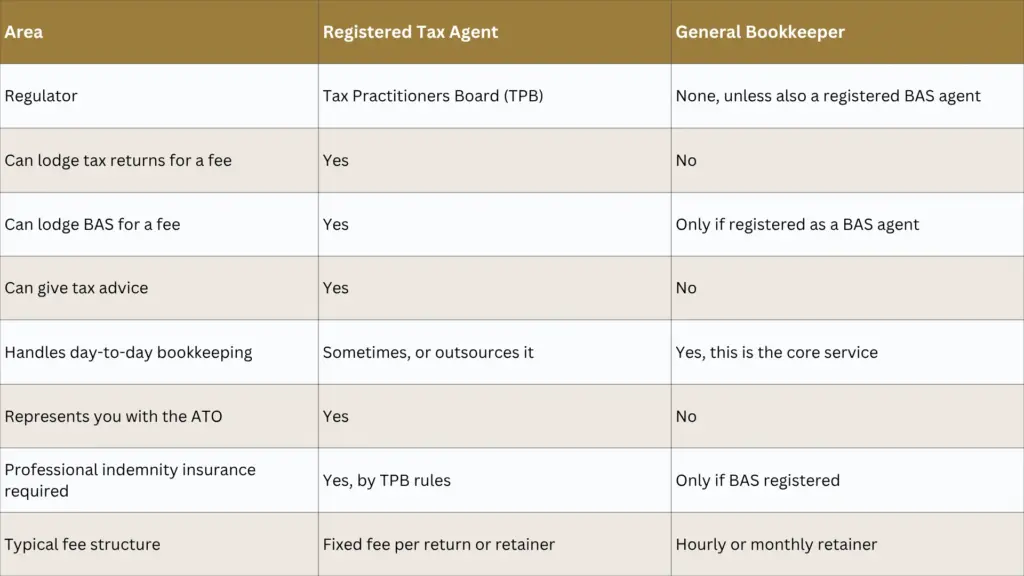
Tax Agent vs Bookkeeper — At a Glance
A registered tax agent focuses on tax compliance, tax returns, tax advice and dealings with the ATO. A general bookkeeper handles day-to-day financial records, including transactions, reconciliations, payroll and invoicing. For many Australian small businesses, using both can provide complete support — with each professional handling the areas they are qualified and authorised to manage.
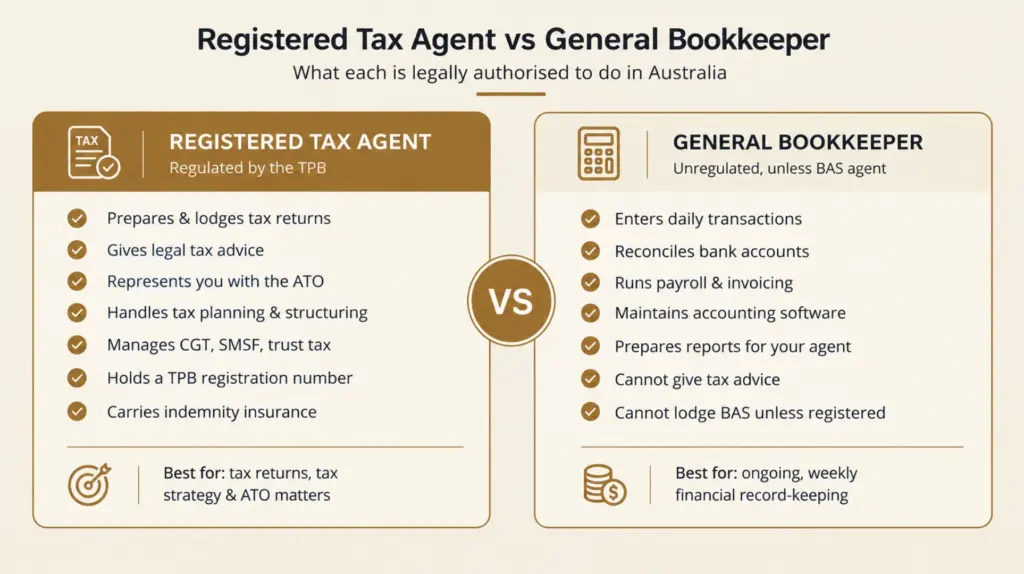
Steps to Choose Between a Tax Agent and a Bookkeeper
1. Define what you actually need done. If you need a tax return lodged, tax advice, or ATO representation, you need a registered tax agent. If you need daily transactions entered and accounts reconciled, a bookkeeper covers it.
2. Check whether you need both. Most growing businesses use a bookkeeper for weekly record-keeping and a registered tax agent for BAS, tax returns, and planning — the two roles work well together rather than as a choice of one or the other.
3. Verify TPB registration before engaging anyone. Search the person or firm’s name on the TPB register and confirm their registration is current, not suspended or terminated.
4. Ask for their registration number upfront. A legitimate registered tax agent or BAS agent will give you this without hesitation, usually on their website or in their engagement letter.
5. Compare fee structures. Tax agents often quote a fixed fee per return; bookkeepers typically charge hourly or a monthly retainer for ongoing work.
6. Confirm indemnity insurance. Registered agents are required to hold professional indemnity insurance under TPB rules — ask to see evidence if it matters to your engagement.
7. Start with a scoped engagement. Agree in writing what’s covered before work begins, so there’s no ambiguity about who is doing your tax return versus your bookkeeping.
How to Check If an Accountant Is TPB Registered
Quick Answer
The TPB register is the single source of truth for verifying any tax or BAS agent in Australia. It’s free, public, and takes under a minute to check. Search by the practitioner’s name, business name, or registration number, and the result will show their current registration status, registration type, and expiry date.
How to Verify a Tax Agent's Registration in Australia
- Visit the Tax Practitioners Board website and open the public register.
- Search using the agent’s full name or the business trading name.
- Confirm the status field reads “Registered” and check the expiry date hasn’t passed.
- Cross-check the registration number against the one they’ve given you in writing.
- Look for any conditions or sanctions listed against the registration.
How to Find a Registered BAS Agent in Australia
A BAS agent has a narrower TPB registration that authorises them to prepare and lodge Business Activity Statements for a fee, without the full scope of a tax agent’s registration. To find one, use the same TPB register search and filter for “BAS Agent” registration type, or ask a bookkeeper directly whether they hold BAS agent registration before engaging them for BAS lodgement work.
Registered Tax Agent Near Parramatta for Small Business
If you’re a small business owner in Parramatta, Norwest, or Blacktown searching for a registered tax agent near Parramatta for small business support, look for a local practice that shows its TPB registration upfront, quotes fees in writing before work starts, and is willing to explain your return before it’s lodged not just process it silently. Local, face-to-face availability also matters if you’d rather sit down with someone than manage everything over email.
What to Do If a Tax Agent Isn't on the TPB Register
Quick Answer
If a search of the TPB register returns no result, or shows the registration as terminated or suspended, treat this as a hard stop. Preparing or lodging tax returns for a fee without registration is a breach of the Tax Agent Services Act, and you have no consumer protection or complaints pathway if something goes wrong. Ask the person directly for clarification, and if their answer doesn’t match the register, walk away and report the conduct to the TPB.
How to Read a TPB Registration Record
Once you find a practitioner on the register, the record will typically show:
- Registration type — tax agent, BAS agent, or tax (financial) adviser.
- Registration number — a unique identifier you can quote back to confirm identity.
- Status — registered, suspended, or terminated.
- Registration and expiry dates — registrations are typically renewed every three years.
- Conditions — any restrictions placed on what the practitioner can practise in.
- Business name — the trading entity the individual practises under, if applicable.
Conclusion
Navigating compliance and financial management for an Australian small business comes down to matching the right expert to the task. A general bookkeeper ensures day-to-day transactions remain organized, while a registered tax agent protects your business legally at tax time, handles tax planning, and interfaces directly with the ATO.
By defining your requirements, verifying credentials on the Tax Practitioners Board (TPB) register, and establishing clear engagement scopes, you safeguard your business against unlodged obligations and unregistered practices. Combining daily bookkeeping efficiency with the strategic tax oversight of a registered tax agent gives your business a strong, compliant foundation to grow with confidence.
We are registered tax agents helping Parramatta, Norwest and Blacktown small businesses tell the difference between good bookkeeping and good tax advice — and get both done properly. We show you our TPB registration before you ask, and agree to every fee in writing before we start.
Frequently Asked Questions.
A registered tax agent is licensed by the TPB to lodge tax returns and give tax advice. A bookkeeper manages daily transactions and record-keeping but cannot legally lodge returns or give tax advice unless separately registered as a BAS agent.
Only if they hold a current BAS agent registration with the TPB. A general, unregistered bookkeeper cannot lawfully lodge a BAS for a fee.
Search their name on the TPB public register at tpb.gov.au and confirm the status shows as "Registered" with no expired or suspended flags.
Most small businesses benefit from both: a bookkeeper for weekly transaction entry and reconciliation, and a registered tax agent for BAS, tax returns, and tax planning.
You lose consumer protections, have no formal complaints pathway, and the person is breaching the Tax Agent Services Act by charging a fee to lodge returns without registration.