




Top ATO Red Flags in 2026: The Tax Mistakes Most Likely to Get You Audited

The Top Tax Mistakes and Red Flags
Tax Mistakes can lead to an ATO review when deductions are unsupported, rental expenses are misapportioned, or side income is not properly declared. Nobody plans to get audited. Most people who end up under ATO review didn’t do anything deliberately wrong; they claimed a deduction without keeping the receipt, misjudged how to apportion a rental expense, or simply forgot that income from a side platform still needs to be declared.
For people who are looking for business accounting, tax and SMSF support in Sydney, keeping accurate records and understanding your tax obligations can help prevent these common issues. The problem is that the ATO’s ability to catch these gaps has changed faster than most taxpayers’ habits have. This article walks through exactly what’s triggering audits in 2026, what happens if you’re flagged, and how to keep your return clean before you lodge, not after.
Quick Answer
Why 2026 is different
Every tax season brings warnings about audits, but 2026 is genuinely a shift, not just recycled advice. The ATO has significantly expanded its data-matching capability, now drawing on more than 2.7 billion data points a year from banks, employers, private health insurers, share registries, crypto exchanges, and gig economy platforms. Returns are compared against this data automatically, before a human ever looks at the file. That means discrepancies that once took months to surface are now flagged within weeks of lodgement.
The ATO has also named its two priority areas for 2026 explicitly: work-related deductions and omitted income, with particular attention on side hustles, cash jobs, and rental and interest income.
The top red flags
1. Work-related deductions without proper records
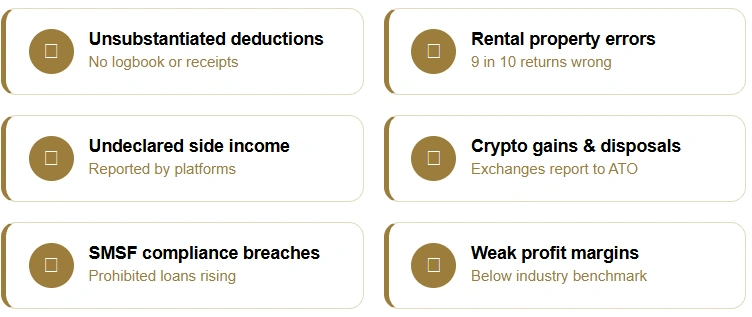
Unusually high deductions relative to your occupation and income, home office claims that don’t match your actual work pattern, and vehicle claims without a logbook are all flagged automatically when they sit outside the ATO’s benchmarks for your industry. The fix isn’t claiming less than you’re entitled to — it’s keeping the receipts, logbooks, and diary records that back up what you claim.
2. Rental property errors
This is one of the most error-prone categories the ATO reviews. Recent ATO reviews found errors in around 9 out of 10 rental property returns examined most commonly, claiming capital improvements as immediate repairs, incorrect interest apportionment on loans partly used for private purposes, and deducting expenses on a property that wasn’t genuinely available for rent.
3. Undeclared side hustle, gig, or cash income
Income from platforms like Uber, Airtasker, or online marketplaces is reported to the ATO directly by those platforms. If that income doesn’t appear on your return, it’s an immediate, automatic mismatch — not a judgement call the ATO has to make.
4. Crypto gains and disposals
Australian crypto exchanges report transaction data directly to the ATO. Failing to declare capital gains on disposals, staking rewards as assessable income, or even crypto-to-crypto swaps (which are a CGT event, not a non-taxable exchange) is one of the fastest-growing categories of audit activity.
5. SMSF compliance breaches
For trustees, the ATO has flagged intensified reviews of self-managed super funds in 2026, with prohibited loans and illegal early access schemes reportedly rising more than 50% in some categories. This is a specialist area SMSF returns should be handled by a tax agent with specific SMSF experience, not general tax knowledge alone.
6. Business figures that don't match industry benchmarks
For business owners, profit margins that sit well below the ATO’s benchmark for your industry can trigger an automated review, as can inconsistencies between your BAS lodgements and your annual tax return.
The Cost of Getting It Wrong: Penalty Tiers
If the ATO determines you underpaid tax due to incorrect or unsupported claims, you must pay the tax shortfall plus interest. Administrative penalties are applied based on your level of care:
- 25% Shortfall Penalty: Failure to take reasonable care (careless errors, lack of receipts).
- 50% Shortfall Penalty: Recklessness (disregarding tax rules without explicit intent to defraud).
- 75% Shortfall Penalty: Intentional disregard of the law (deliberate evasion or false statements).
Note: Making a voluntary disclosure to the ATO before an audit or review commences can reduce these financial penalties by up to 80%.
How to Audit-Proof Your Tax Return Before You Lodge
Taking a proactive approach before submitting your figures is the single best way to avoid unwanted ATO correspondence.
- Maintain a 5-Year Document Vault: Retain all digital receipts, tax invoices, bank statements, and logbooks for at least 5 years from the date you lodge. For capital assets (like property or crypto), hold records for 5 years after the asset is sold.
- Separate Personal and Business Banking: Never run personal living expenses through a business or corporate account.
- Reconcile BAS Against Annual Income: Always perform a quarterly and end-of-year reconciliation to ensure your GST/BAS labels match your annual return total.
- Cross-Check ATO Pre-Fill Data: Before lodging, review your pre-filled dividend, interest, health insurance, and platform income summaries against your actual bank statements to catch omissions early.
What happens if you're flagged
Being flagged doesn’t automatically mean a full audit. The ATO’s process typically starts with a review of a request for information covering a defined period commonly the last two financial years for individuals, or the last eight quarters for a business. If your response resolves their concern, it often ends there. If not, it can escalate to a formal audit. Penalties for errors found during an audit generally range from 25% to 75% of the tax shortfall, but making a voluntary disclosure before you’re contacted can reduce that penalty by up to 80%.
External resources
ATO — Reviews and audits — the ATO’s own explanation of how reviews and audits work
ATO — Fraud, evasion and the normal period of review — official guidance on how far back the ATO can review a return
Conclusion
None of the categories above are new deductions, rental income, and undeclared earnings have always mattered to the ATO. What’s changed in 2026 is the speed and scale of detection, not the underlying rules. The businesses and individuals least likely to be flagged are the ones with clean, substantiated records lodged by someone who checks the numbers before they go to the ATO, not after.
If you’d rather have a registered tax agent review your position before you lodge than find out about a mismatch after the fact, Sanath Accounting can go through your return with you and flag anything that needs tighter substantiation before it becomes a problem.
Frequently Asked Questions.
The ATO will typically request specific documents and explanations first (a review), rather than launching straight into a full audit. Most matters are resolved at this stage if you can substantiate what you've claimed. A full audit is a more in-depth examination and is usually reserved for cases where the initial review doesn't resolve the ATO's concerns, or where fraud is suspected.
For most individuals, the standard review period is two years from the date your assessment was issued. For some business structures, and in cases involving suspected fraud or evasion, there's no time limit the ATO can go back as far as it needs to.
Not claiming what you're legitimately entitled to is not a red flag. The risk comes from claiming without evidence to support it, or claiming amounts well outside what's typical for your occupation or industry. Keep records for everything you claim and you're protected either way.
Correct it as soon as you notice, ideally through a voluntary disclosure to the ATO before they contact you. Voluntary disclosures made before an audit begins can reduce any penalty by up to 80% compared to the ATO finding the error itself.
It reduces the risk of the kind of substantiation and calculation errors that trigger reviews in the first place, because a registered tax agent checks your figures, apportionment, and evidence before lodgement rather than after. It doesn't make you audit-proof, nothing does but it removes the most common, avoidable causes of being flagged.